
Should You Apply to BS/MD Programs? (Who Should Not Apply)
Should you apply to BS/MD programs? Four signs a guaranteed medical school seat may be the wrong move for you, from fear to family pressure.


You can get straight A’s, crush the MCAT, and match into your top choice specialty. But what if you wake up in 10 years thinking, “I made a huge mistake.”
Just because you have the academic skills and work ethic to be a doctor doesn’t mean it’s your destiny. And realizing that a decade into your career is devastating financially, emotionally, and spiritually.
These are the six signs that suggest you will regret becoming a doctor one day. And one of them, you absolutely need to figure out before your future breaks your bank or your heart.
The first sign is you’re in love with the idea of being a doctor. The title, the prestige, the money, and how impressive it sounds at a dinner party or on a dating profile.
But here’s the problem: you haven’t spent real time understanding what you’d actually be doing every single day for the next 30 years. There’s a critical difference between loving the idea of being a doctor and loving what doctors actually do. One leads to a hollow career where you feel empty despite the credentials. The other leads to fulfillment.
The glory of being able to call yourself a doctor is minuscule compared to the 8 to 10 hours a day you’re spending actually being a doctor, Monday through Friday, month after month, year after year.
If you haven’t immersed yourself in a clinical setting, you’re chasing a concept, not a career. And you can’t fake your way into the second one just because you’re good at taking tests.
You need to fall in love with what doctors do, not what they are. Shadow physicians extensively. Immerse yourself in clinical settings. Watch our So You Want to Be and Day in the Life series to better understand the nuances and specifics of each specialty. See the actual day-to-day reality, like the monotony, the paperwork, and the moments that don’t make it into Grey’s Anatomy.
This is what it takes to truly understand if the life of a doctor is right for you.
But even if you love the work itself, there’s another problem most people miss.
The next sign is that you have a competing passion that’s equally strong as medicine, and maybe even stronger. You keep thinking, “What if I pursued that instead?” You fantasize about the other life you could be living.
Here’s the problem: becoming a doctor is a full-time commitment. You can’t dabble in architecture while committed to medicine. This isn’t like working an office job while pursuing web design on the side. Medicine consumes you. 4 years of medical school, 3-7 years of residency, then decades of practice. If your heart isn’t fully in it, that’s hundreds of thousands of dollars you could have invested in your true passion, plus over 30 years of wondering what could have been.
Don’t let that be you. Test your competing passion seriously before you commit to medicine. Pursue it for a defined period. Work in that field. See if it holds up under real scrutiny. Then ask yourself which path you’d regret not taking more. That’s your answer.
This third sign is arguably the most dangerous because it has a massive impact not only on your future career but also on your relationships.
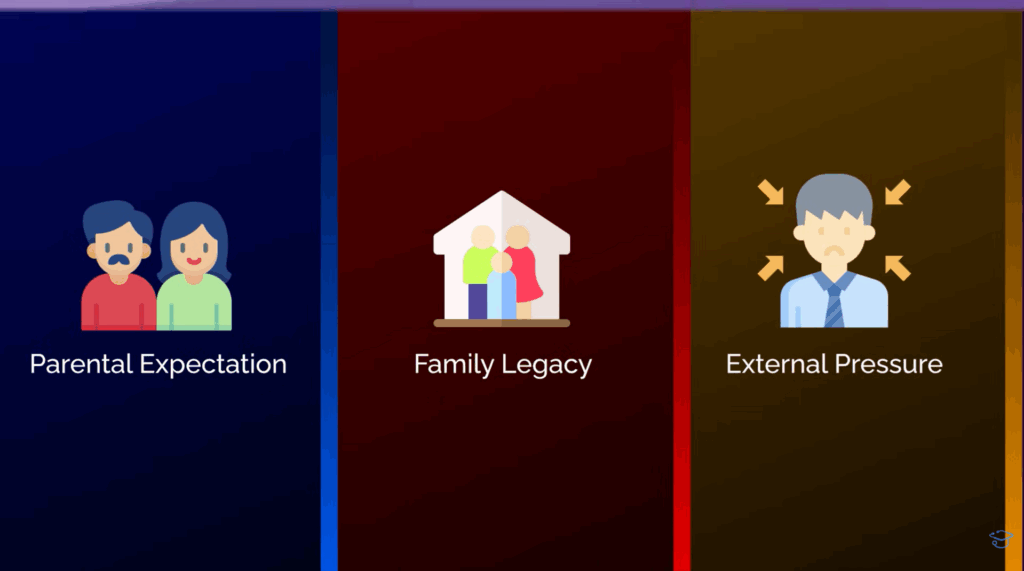
What if it’s not another passion pulling you away, but someone else pushing you forward? Is your motivation for medicine driven by parental expectations, family legacy, or external pressure?
One classmate I had in med school got straight A’s and a 522 MCAT. Both parents were doctors. She applied to med school because it was expected, not because she felt called to it.
By second year, she was going through the motions while her classmates, including me, were energized despite the exhaustion. With each passing systems block and clerkship rotation, she felt more trapped in a career path that was never her idea to begin with. She thought she couldn’t pivot without disappointing everyone who had been proud of her.
The deepest regret you’ll have about becoming a doctor is spending over a decade pursuing someone else’s vision for your life. Ask yourself: if external pressures from the people in your life were not a factor, would you still want to become a doctor? Write down your answer when you’re alone, not when family is around. Your gut reaction in that moment is what matters.
But even if you want this for yourself, there’s another kind of trap waiting, and it’s one that locks you in whether you like it or not.
You understand logically that debt is “a thing,” but you haven’t actually run the numbers on what it means for your life and career freedom.
The average med student graduates with $260,000 in debt. And this is only the average. Many students from wealthy families graduate debt-free, while many others leave with $400,000 to $500,000 in debt. This locks you in. You can’t take a lower-paying dream job, can’t pivot to a less lucrative field, can’t afford to take risks, and all because you need to pay off debt for the next decade or more.
But keep in mind, if you don’t come from money, there are ways to secure scholarships and save yourself hundreds of thousands of dollars. I graduated with only $20,000 in med school debt, despite paying for everything myself—college, med school, all of it—with zero family help. If you want to know how exactly I pulled that off, check out the Med School Insiders Blueprint channel, where we dig deep into the strategies that actually move the needle in getting into med school, and more advanced strategies such as securing grants and scholarships, based on our experience 1-on-1 helping over 10,000 students succeed.
Before you commit to medicine, model out your actual financial reality. Calculate your expected debt, interest accumulation during residency, and realistic repayment timeline based on your likely specialty. See what your monthly payments will be. Understand what financial flexibility you’ll actually have. Or won’t.
But money isn’t the only way medicine locks you down—it also dictates where you can live and for how long.
You crave movement and spontaneity. You want to relocate on your own timeline, experience new cities, and travel freely. The idea of being geographically locked for 3-7 years during residency, then tethered to early-career hospital contracts, makes you anxious.
Medicine, and especially medical education, is the death of whimsical travel adventures on your own terms and timeline. You can’t be spontaneous because your schedule is locked in. And not only that, so is your geographic location.
While you can move from one hospital to another, or even from city to city, it’s a complex process that’s far from spontaneous. You might suppress these feelings during training, but they don’t disappear. They build. And eventually, the geographic cage will leave you feeling trapped and burned out.
Fortunately, after 4 years of med school and 3-7 years of residency, you’ll have more geographic flexibility. Some career paths offer significantly more freedom, like emergency medicine, locum tenens work, and telemedicine-heavy fields.
At this stage, you need to research which specialties align with your values before you commit. Check out the free quiz at specialtyquiz.com, which asks you questions based on your personality and preferences to help you identify the nine personality traits that align with your ideal specialty.
But even if you can live with geographic constraints, there’s one final trap that catches those who crave independence.

What most premeds don’t realize is that even as an attending, you’re not truly autonomous. You’re attached to a hospital system. You report to administrators who’ve never treated a patient. You’re “in charge” of patient care on paper, but you’re constantly navigating insurance denials, hospital policies, and bureaucratic red tape that prevents you from doing what you know is right.
You can’t just decide to take three months off. You can’t unilaterally change how you practice. You’re bound by contracts, call schedules, and institutional rules that dictate when, where, and how you work.
You must acknowledge this reality upfront. About 6-10% of physicians work in cash-based practices, which offer more autonomy, but even then, you’re managing a business with its own restrictions.
Imagine spending years training to be the expert, only to find yourself boxed in by systems you can’t control. By the time you realize the job comes with golden handcuffs, you’re too deep in to walk away. If true independence matters more than helping patients within a system, entrepreneurship or a different healthcare path might be better suited to you.
So, will you regret becoming a doctor?
As you can see, it all comes down to whether you’re choosing medicine for what it actually is, not what it looks like from the outside. Prestige fades. Titles feel hollow when the day-to-day work drains you.
But if you’re drawn to the actual practice of medicine, if you’re willing to trade autonomy and spontaneity for the privilege of doing work that matters, then those sacrifices won’t feel like regret. They’ll feel like the worthwhile cost of doing something you believe in.
If you saw yourself in a few of these signs, don’t ignore that. Because medicine is a beautiful career path. It’s one of the most fulfilling and empowering careers you can pursue. But only if it’s the right fit. And forcing yourself into the wrong career, no matter how prestigious, is a tragedy.
So the real question is: what if you’re on the other side? What if you’re wondering whether you actually have what it takes?
That’s exactly what I cover in Signs You Should Become a Doctor, where I break down the seven key traits that predict long-term success in medicine.

Should you apply to BS/MD programs? Four signs a guaranteed medical school seat may be the wrong move for you, from fear to family pressure.

How many publications do you need for residency? See 2026 research item averages by specialty and how they’ve changed since 2020.




This Post Has One Comment
Thank you very much, Mr. Jubbal, for your inspiring article. I hope this serves as a reflection for me and everyone else regarding our aspirations to become doctors in this life, so that we can all avoid any regrets in the future. Warm regards. much love