In 2026, How Many Publications for Residency? (By Specialty)
How many publications do you need for residency? See 2026 research item averages by specialty and how they’ve changed since 2020.


Your personal statement is the one piece of your application where your 3.9 GPA and 515 MCAT can’t save you. It’s also the one piece that tanks more otherwise-competitive applicants than any other component.
This isn’t an essay where you list your accomplishments in paragraph form. Admissions committees already have your CV. They don’t need you to tell them you’re hardworking and compassionate. They need you to prove it.
Your personal statement answers one question: why medicine? Not the generic “I want to help people” answer every applicant gives, but your specific story. What experiences shaped you? What drives you? Why are you an asset to their incoming class?
Most premeds overthink this. You’re training to be a doctor, not a novelist. But that doesn’t mean you can wing it. A weak personal statement will cost you interviews, even with stellar stats. A strong one can compensate for gaps elsewhere in your application.
This guide breaks down exactly how to write a personal statement that gets you interviews. We’ll cover how to start, what to include, what to avoid, and how to edit your way to a final draft that stands out.
A personal statement has a maximum of 5,300 characters, about 1.5 pages of single-spaced, 12-point Times New Roman font. The challenge isn’t filling in words; it’s selecting the key moments in your life that made you want to be a doctor and expressing them concisely.
A personal statement is made up of three parts:
It’s essentially a short essay that uses your life experience to succinctly demonstrate why you’re the right person for the job. If someone’s making a movie about your life and the events that shaped your desire to become a doctor, what key moments do you want to highlight?
Your introduction must capture an admissions committee’s attention. Use the introduction to hook your readers. The first few sentences should entice them to read more.
There isn’t a perfect number of paragraphs or set structure. This is where you discuss the experiences that have shaped your personality, your desire to study medicine, and your dreams for the future.
This is a summary of your statement, and it should tie directly into your introduction. Now is the time to emphasize why you want to be a physician and your future goals.
Admissions committees have your CV and transcripts. The personal statement answers a different question: Do you have what it takes to succeed in medical school, and what will you bring to our class?
They’re not looking for a list of accomplishments. They want your story, and they want you to show, not tell. Saying you’re compassionate doesn’t mean anything. Sharing the specific moment that taught you what compassion means in medicine? That’s what they remember.
Here’s what they’re evaluating:
Authenticity and self-awareness. Genuine reflection on why medicine is right for you specifically, not platitudes that could apply to anyone.
Communication skills. Can you articulate complex ideas clearly and tell a compelling story? These are essential physician skills.
Maturity and professionalism. How you discuss challenges reveals depth. They want reflection with perspective, not just event recaps.
Commitment to medicine. Show genuine passion rooted in meaningful experiences, not surface-level motivations or external pressure.
You are the main character. Even when discussing mentors or patients, you must remain the focus of every anecdote. Don’t let your inspiring doctor or moving encounter become the star. Bring it back to how it shaped you.
What you uniquely contribute. What will you bring that others won’t? Highlight your distinctive background, experiences, or perspective.
You’re not the first person to write a personal statement. Every matriculated medical student has one, which means you have examples to learn from.
Start by reading successful personal statements. If you know people who got into med school, ask to see theirs. We have a database of personal statements donated by successful applicants. Reading these will give you a sense of themes, concepts, strategies, and stories that work.
The feedback included with each example breaks down what makes it effective. Pay attention to both the essays and the commentary, as that’s where you’ll learn what admissions committees actually want.
Don’t expect to find a blueprint you can copy. Every personal statement is unique to the writer. Use these examples to understand what works and spark ideas for your own story.
Reading bad personal statements can also teach you what to avoid.

Don’t brainstorm yet. Just reflect. Think back on key moments from your past without worrying about creativity or “right” answers.
Think of your personal statement as your superhero origin story. You have strong grades and aptitude for science, but why medicine? What moment revealed you had to be a doctor?
Every premed has similar surface motivations: intellectual interest in medicine, desire to work with people, and drive to help others. The applicants you’re competing with want the same things. The key is digging deeper. What do you value most about becoming a doctor, and what tangible experiences shaped those values?
Use our list of 25 medical school personal statement prompts to uncover moments you might not have considered. Questions like “Who has had the greatest impact on who you are?” or “What’s the biggest obstacle you’ve overcome?” can unlock memories beyond “I want to help people.”
When reflecting, clear your mind first. Keep a notebook or document handy. Let ideas flow without judgment, and don’t erase anything. Even weak ideas can spark better ones later.
Your personal statement isn’t comprehensive. It’s focused. Choose three to four traits that best represent who you are and why you’re pursuing medicine.
Which experiences genuinely shaped you? Research projects, clinical work, challenges you’ve overcome, and leadership roles. Pick the ones that reveal your values and that you have the most to say about.
If you claim you’re resilient or compassionate, you need concrete stories to back it up. The admissions committee wants evidence, not assertions.
Personal statements typically highlight:
Choose stories you can speak about authentically during interviews, ones you actually want to be asked about. Writing takes multiple drafts, and you may realize your first choices don’t define you well enough. That’s normal.
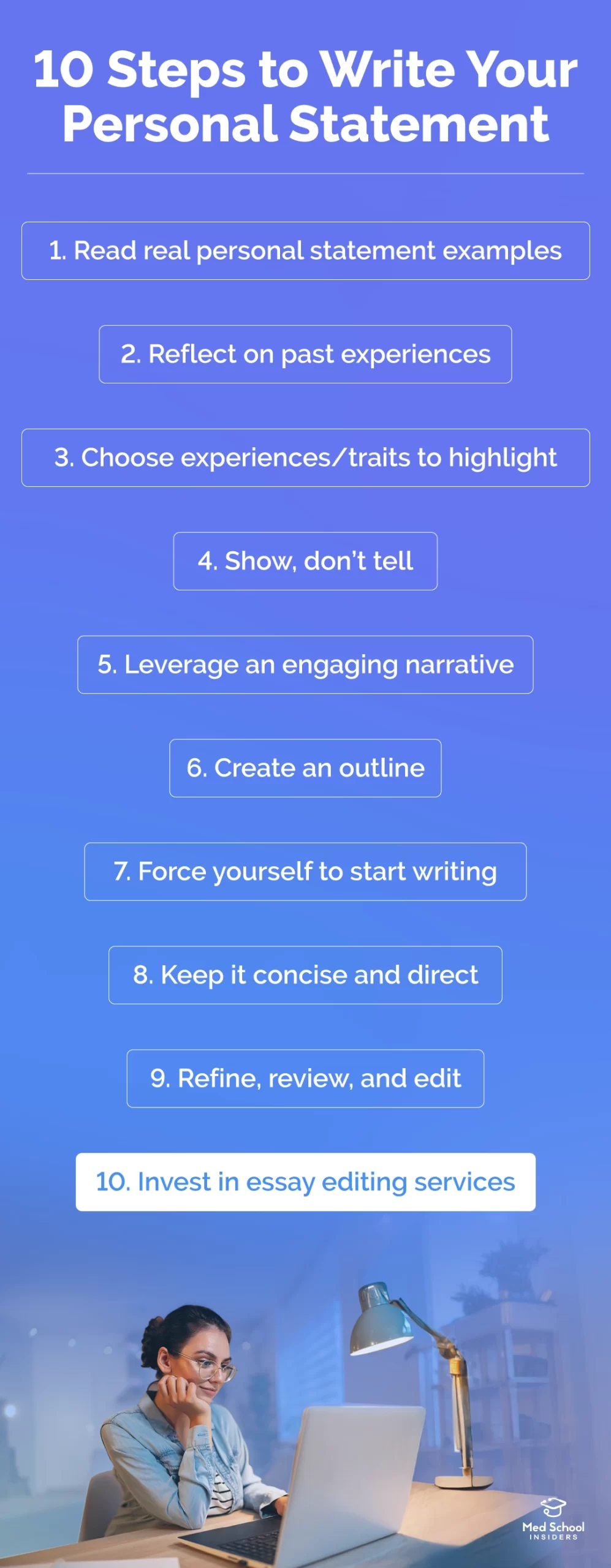
This is the number one mistake: telling admissions committees you’re compassionate or driven without demonstrating it through specific examples.
Think back to math class when you had to show your work for full credit. Same here. The admissions committee won’t take your word for it. They want evidence.
This is telling: “I learned to be compassionate through my volunteering experience.”
This is showing: “While collecting laboratory samples, I talked to a patient who only spoke Spanish. The interpreter hadn’t arrived, and my Spanish was basic at best. I asked about her day and family, which lifted her spirits. This taught me the importance of personal connections, even when I’m not perfectly equipped for them.”
The word “compassionate” doesn’t appear in the second example. But you feel it in the action.
Don’t tell them you’re empathetic. Show the moment you sat with a patient who just received bad news.
Don’t say you’re intellectually curious. Show staying up until 3 AM because you needed to understand why your hypothesis was wrong.
Don’t claim you’re resilient. Show the specific challenge, how you felt when you failed, what you did next, and what you learned.
If someone’s making a movie about your life, what key moments would prove you’re an excellent future physician? Those are your stories.

Too many personal statements read like a CV in paragraph form. Use a narrative approach that makes the admissions committee excited to learn more about you.
Highlight how your experiences make you an asset. Where appropriate, use vivid language and sensory details.
Weak: “I sat in the hospital waiting room, eager for what was to come.”
Strong: “My hair stood on end as my stomach tied itself in knots. I could feel the cold hospital air dance around me as I waited, my mind racing through everything I was about to witness.”
The second version brings the reader into the moment. You can feel the nervousness and anticipation.
But clarity above all. Don’t get so poetic that you obscure your meaning. Beautiful language means nothing if your point isn’t clear.
After you write a sentence with vivid language, ask: “Is it completely clear what I’m saying, or am I prioritizing sounding good over being understood?” If there’s any ambiguity, choose clarity.
Admissions committees read hundreds of statements. The ones that tell a story, that take them on a journey, are the ones they remember.
After reflecting on your experiences, create an outline. You don’t need to stick to it rigidly, but here’s the general structure:
Establish a central theme in the introduction that explains your desire to become a doctor. Each paragraph illustrates how your experiences shaped that desire. The conclusion ties back to your theme, making your statement feel like a consistent, interconnected story.
That’s it. The outline keeps you on track and prevents tangents that don’t serve your narrative.
Feeling overwhelmed is normal. If you’re not overwhelmed, you’re not taking this seriously enough.
Start with a theme, but don’t get stuck on the perfect opening sentence. That comes later. Once you have an outline, just start writing.
The first words you write won’t be perfect, but they’ll get you started. Expect the first draft to be terrible. That’s okay. First drafts are never perfect.
Your first draft probably won’t look anything like your final essay. Get the ideas out and worry about editing later.
In subsequent drafts, cut words. Forget extravagant word choices and convoluted sentences. You don’t have space for tangents.
Use clear language over complicated words. Thesaurus abuse weakens your message.
Examples:
Before: “Throughout the duration of my clinical volunteering experience at the community health center, I had the opportunity to witness firsthand the various multifaceted challenges that patients from underserved communities face on a daily basis.”
After: “Volunteering at the community health center showed me the daily challenges underserved patients face.”
We cut 32 words to 15 and said the exact same thing.
Every word should earn its place. If it doesn’t add meaning, emotion, or clarity, cut it. If a sentence can be understood multiple ways, rewrite it. If a paragraph doesn’t support your main point, cut it.
You have 5,300 characters. Concise doesn’t mean short—it means not using more words than necessary.
Once you complete a draft, step away. Go for a walk, read a book, hit the gym, hang out with friends.
The longer you can let it sit between drafts, the better. You want to return almost as if you’re reading it for the first time.
When you’ve just finished writing, your brain knows what you meant to say. It fills in gaps, smooths over awkward phrasing, and makes it seem better than it actually is.
But when you come back after a few days, you read what’s actually on the page, not what you meant to write. That’s when you catch sentences that don’t make sense, abrupt transitions, unclear points, sections that drag, and places where you need more detail.
Take at least three to five days between major drafts. A week is even better.

This isn’t something you can finish in a few days. Get started early. It will take several drafts before you land on something that impresses admissions committees.
Editing should be the longest part of the process. This is where good writing becomes great writing.
A rushed personal statement can derail your chances. Strong applicants with great stats don’t get the interviews they deserve because they submitted mediocre statements.
Use editing apps like Grammarly and Hemingway Editor, but don’t rely solely on bots. Ask friends and family for brutally honest feedback. Reach out to mentors who’ve been through this process.
Spelling or grammar mistakes signal carelessness and are automatic red flags. Read over your work carefully, and ask others you trust to do the same.
Your statement deserves multiple rounds of editing from yourself and trusted peers. While friends and family know you well, you should also seek advice from someone with admissions committee experience. If you don’t have a mentor with that background, professional services who understand what adcoms want can make the difference.
Your personal statement is one of the most important pieces of your application. An excellent essay can secure your interview offer. A poorly-written one can sink your chances, even with stellar stats and impressive extracurriculars.
Friends and family can provide valuable feedback, but they don’t know what admissions committees look for. Professional editing services with physicians who’ve served on admissions committees can provide insights that others can’t, like analysis of content, tone, and how your statement fits into your overall narrative.
Med School Insiders offers personal statement editing packages, from general editing to unlimited guidance with a physician advisor.
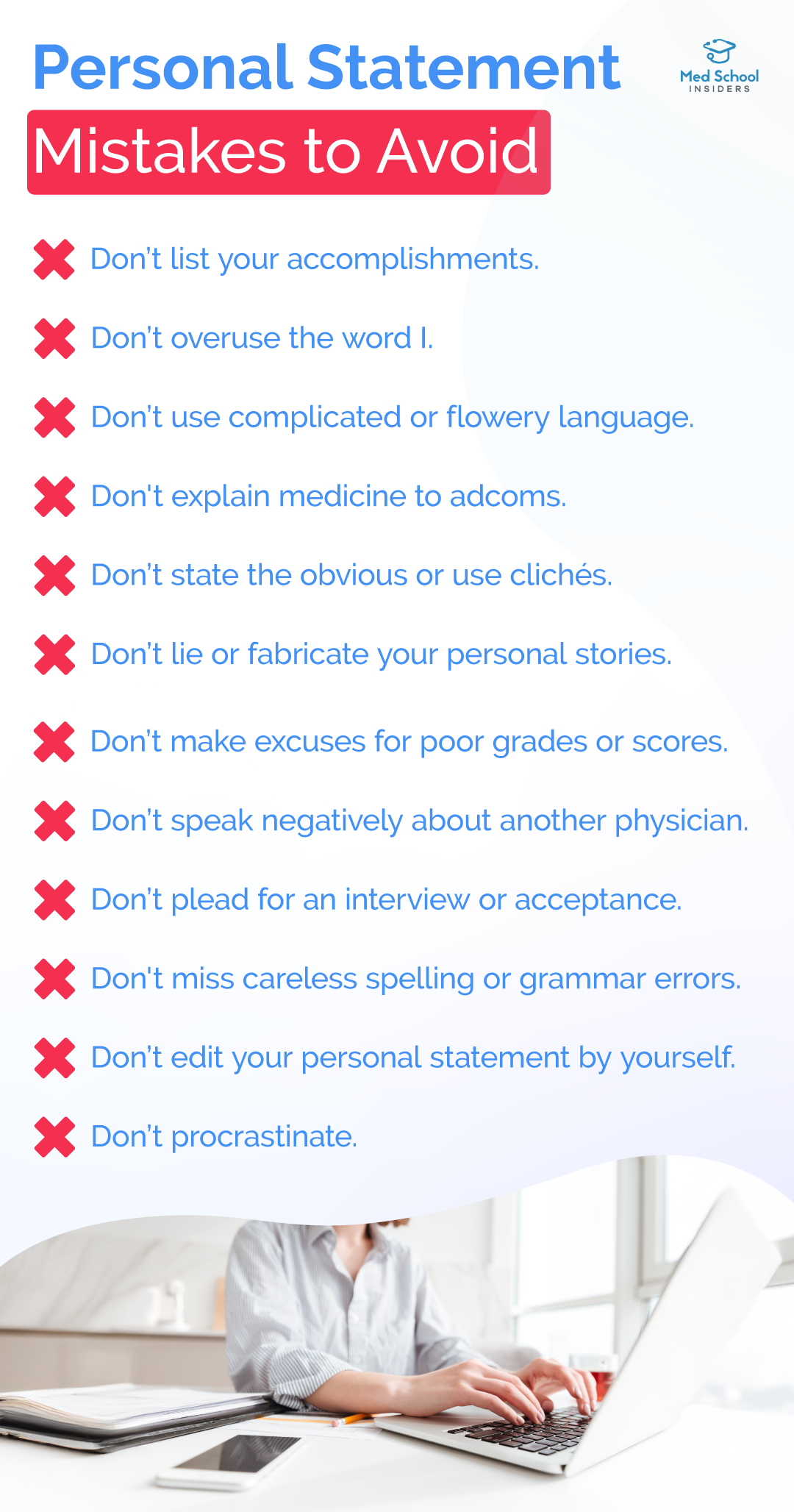
Avoid the following common personal statement mistakes.
The AMCAS personal statement has a maximum of 5,300 characters (including spaces), which is roughly 1.5 pages single-spaced in 12-point Times New Roman. The challenge isn’t filling the space; it’s selecting the most important moments from your journey and expressing them concisely.
Plan for several weeks minimum. The writing itself might take a few days, but editing should take much longer. You’ll need multiple drafts, time away between revisions, and rounds of feedback from others. Starting 2-3 months before your application is due gives you enough time to write, edit, get feedback, and refine without rushing.
Med School Insiders has a database of personal statements from successful applicants, including detailed feedback on what makes each effective. You can also ask people you know who matriculated to medical school if they’re willing to share theirs. Reading both good and bad examples helps you understand what works and what to avoid.
Only if they’re genuinely formative to your journey toward medicine. Don’t include hardships just to seem more compelling. If you do write about challenges, focus on what you learned, how you grew, and how the experience shaped your understanding of medicine or yourself as a future physician. Avoid writing a sob story. Admissions committees want to see resilience and reflection, not just struggle.
Yes. The AMCAS personal statement goes to every school you apply to. Don’t try to customize it for specific programs; that’s what secondary essays are for. Your personal statement should tell your story in a way that works for any admissions committee.
That said, this depends on whether you’re applying to osteopathic (DO) schools as well or medical schools in Texas, as AACOMAS personal statements and TMDSAS personal statements have different requirements.
Don’t list accomplishments, rehash your CV, use clichés (“I want to help people”), make excuses for poor grades, lie or exaggerate, speak negatively about healthcare professionals, use flowery thesaurus language, or plead for acceptance. Also, avoid making someone else (a doctor you shadowed, a patient) the main character. You need to be the focus.
Not necessarily, but a central thread makes your statement more cohesive. Think of it as your origin story; what core value, realization, or motivation ties your experiences together? It could be intellectual curiosity, a commitment to underserved communities, or an understanding of medicine as both science and art. Whatever it is should feel authentic to you, not forced.
No. Your personal statement goes to every school on your AMCAS application. Never mention specific schools, programs, or cities. Save that for secondary essays, where you can explain why you’re a good fit for each particular school.
Be authentic, but maintain professionalism. You can write about personal struggles, family challenges, or vulnerable moments if they’re relevant to your journey. But avoid oversharing intimate details that don’t serve your narrative or might make admissions committees uncomfortable. Ask yourself: Does this detail add meaning, or is it just TMI?
Keep in mind that anything you write about in your personal statement is fair game to be asked about during your interviews. Don’t write about it if you don’t want to talk about it.
That’s fine. Most successful applicants don’t. You don’t need a near-death experience or life-altering epiphany. Admissions committees value genuine reflection on meaningful experiences over manufactured drama. Focus on the moments, even quiet ones, that shaped your understanding of medicine and yourself.
Most premeds start writing their personal statement with no framework, no strategy, and no idea what admissions committees actually want. Then they spend weeks spinning their wheels.
Our free Personal Statement Guidebook gives you the strategic foundation before you write a single word. Created by doctors who’ve served on admissions committees and helped thousands of students get accepted.
Approach your personal statement with clarity instead of guesswork.

How many publications do you need for residency? See 2026 research item averages by specialty and how they’ve changed since 2020.

Dermatologist vs Plastic Surgeon: Which is the best career path for you? We break down compensation, lifestyle, training, and the pros and cons of each career.