
The “Good Advice” That Keeps Premeds Stuck
Much of the advice premeds hear feels reassuring but quietly increases risk. Learn which common tips keep applicants stuck and what to do instead.


Two doctors, same medical school, same residency training—but their daily reality couldn’t be more different.
One doctor just started her shift at a top Massachusetts hospital. She’s well-compensated, works in a state-of-the-art facility, has strong malpractice protection, and enjoys low burnout rates.
Meanwhile, 1,100 miles south, another doctor is starting his day in rural Alabama—he’s making way less money, dealing with sicker patients who have poor access to care, facing higher malpractice risks, and like more than a third of his colleagues, he’s burned out.
Same degree. Same training. Completely different realities.
This isn’t just about money. It’s about your quality of life, your stress levels, the resources you’ll have, and ultimately, the kind of doctor you’ll become. The state where you choose to practice medicine will shape your entire career.
Today, we’re breaking down Medscape’s latest data on the best and worst states for physicians to practice in, organized by nine regions across the US.
While the US is divided into four major areas—the Northeast, Midwest, South, and West—Medscape breaks it down even further into nine specific regions:
Each region groups states that share similar economic conditions, cultural traits, and healthcare challenges. Let’s dive in.
We’ll start with the New England Region, which is home to Maine, Vermont, New Hampshire, Massachusetts, Connecticut, and Rhode Island.
The best state for doctors? Massachusetts.
Why does Massachusetts come out on top? It dominates healthcare infrastructure with the nation’s top healthcare access and low physician burnout rates.
Financially, doctors here rank third nationwide for compensation. Malpractice insurance may cost more, but there’s a $500,000 damage cap, and lawsuits only succeed 20% of the time.
You’ll also work alongside prestigious institutions like Mass General.
But the worst state for doctors? That’s Maine.
Maine presents a challenging picture for physicians. While living costs and healthcare metrics hit average marks, the practice environment tells a different story.
Healthcare is highly concentrated—one Level 1 trauma center and a single health system controlling one-quarter of state hospitals drive costs beyond national averages.
Compensation for doctors ranks lowest in the region, there are frequent malpractice lawsuits with no damage caps, and cancer is the leading cause of death.
Next up is the Mid-Atlantic Region, which includes New York, New Jersey, Pennsylvania, Delaware, Maryland, and Washington, D.C.
The best state for doctors? Delaware.
Delaware proves that good things come in small packages. Despite being America’s second-smallest state, it delivers big physician advantages.
The financial benefits are clear: the state has no sales taxes, reduced property taxes, and more Social Security income.
Quality-wise, Delaware ranks second nationally for hospital excellence, with low malpractice rates and strong elderly and disabled support programs.
The worst state is Maryland.
And this creates a paradox. On paper, Maryland sounds amazing—it borders Washington D.C., it’s home to world-famous medical institutions, and it has excellent healthcare access.
But practicing here comes with serious downsides. The state has the ninth-highest malpractice payouts nationally, high living costs, and steep taxes.
Most concerning is that Maryland has some of the highest regional burnout rates and relatively low compensation.
Next is the East North Central Region, which is home to Illinois, Indiana, Michigan, Ohio, and Wisconsin.
The best state for doctors? Indiana.
Indiana delivers the holy grail. It offers high pay, low costs, and strong support systems. It has the fifth-highest physician compensation nationally, with low living costs, which means your paycheck goes further.
The legal environment favors doctors. There are rare adverse actions, low malpractice premiums, and high medical resident retention. It also has the nation’s largest medical school—the Indiana University School of Medicine has not three, not six, but nine campuses.
The worst state to practice in? Michigan.
Michigan presents a classic supply-demand mismatch that hurts both doctors and patients. Despite affordable living and flat taxes, physicians face overwhelming challenges.
Primary care shortages hit rural areas hard, creating unsustainable patient volumes and depressed reimbursement. Residents rank among America’s least healthy.
What’s most alarming is that Michigan leads the nation in disciplinary actions against doctors.
Up next is the West North Central Region, which consists of North Dakota, South Dakota, Nebraska, Kansas, Missouri, Iowa, and Minnesota.
The best state to practice in is North Dakota.

North Dakota offers a rare combination: financial stability without stress, low burnout, above-average compensation, and excellent medical resident retention.
The malpractice environment strongly favors physicians with low premiums, low payouts, and manageable risks. The state also has low living costs, reasonable taxes, and healthier-than-average residents.
The worst state in this region is Kansas.
Kansas exemplifies rural healthcare’s challenges, as over 70% face physician and nurse shortages. Chronic diseases also dominate, with heart disease, diabetes, and respiratory conditions worsened by limited care access. The state projects needing 250 additional primary care physicians by 2030.
To make matters worse, physician compensation lags regional averages, making recruitment difficult.
Next, we have the South Atlantic Region, which includes the states of Virginia, West Virginia, North Carolina, South Carolina, Georgia, and Florida.
The best state for doctors is North Carolina.
North Carolina offers small-town charm, low taxes, affordable living, mild weather, and outdoor recreation, all of which can actually reduce physician burnout over time.
Professionally, doctors benefit from a strong healthcare system, low malpractice payouts, and high physician compensation.
The Research Triangle region—Raleigh, Durham, and Chapel Hill—is attracting more and more younger physicians.
But the worst state for doctors is West Virginia.
West Virginia’s natural beauty can’t overcome its healthcare challenges. The state struggles with some of America’s highest malpractice rates, elevated physician burnout, low compensation, heavy tax burdens, and frequent adverse actions against doctors.
The underlying health picture is concerning: widespread poverty, high obesity rates, and extensive smoking create a challenging patient population. Less than half of residents have private insurance, with 24% relying on Medicare and 15% on Medicaid.
Up next is the East South Central Region, which covers Kentucky, Tennessee, Alabama, and Mississippi.
The best state for doctors? Tennessee.
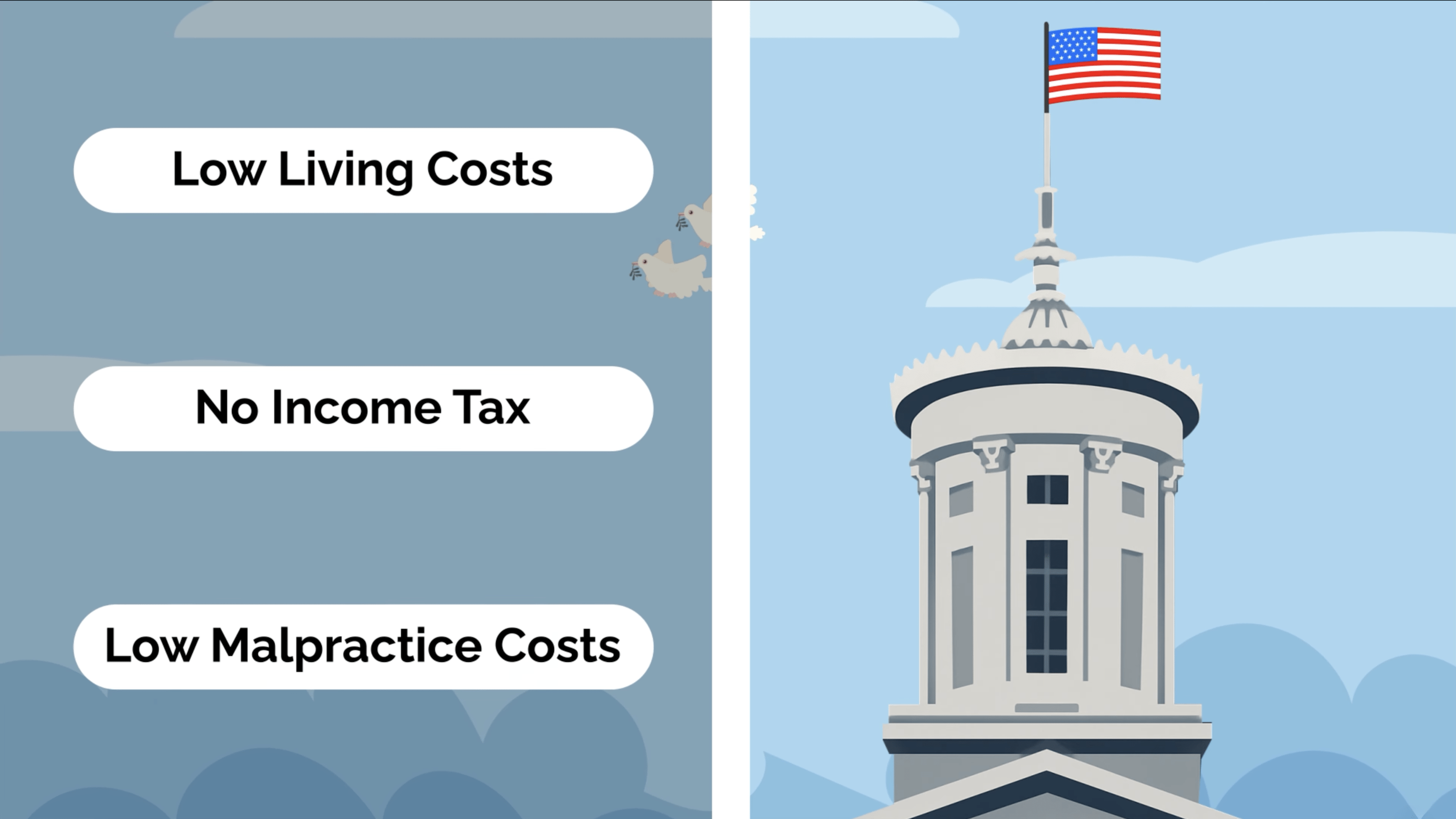
Tennessee has low living costs, no individual income tax, and low malpractice payouts. It also has the second-highest regional physician density with above-average compensation.
The state has implemented laws easing international medical graduate licensing. Combined with steadily decreasing burnout rates, Tennessee is moving in the right direction.
But the worst state to practice in is Alabama.
Alabama faces systemic healthcare challenges and is among the lowest nationally in terms of healthcare access, spending, and outcomes.
Doctors struggle with some of the nation’s lowest compensation while over one-third experience burnout. Low physician density compounds this problem.
The state’s Board of Medical Examiners also actively disciplines doctors for pricing practices.
Then there’s the West South Central Region, which is home to Oklahoma, Texas, Louisiana, and Arkansas.
The best state for doctors is Texas.
Doctors rank among the nation’s top earners with some of America’s lowest malpractice payouts.
Living costs and taxes are manageable, and many med students who train in Texas stay in Texas. This is likely due to Texas medical schools’ strong emphasis on attracting local applicants.
Texas schools offer significant tuition cuts for in-state applicants, and out-of-state matriculants make up only 10% of the student body. Texas even has its own application service for applying to Texas schools called TMDSAS—the Texas Medical and Dental Schools Application Service.
If you’re considering applying to Texas medical schools, visit the Med School Insiders website for comprehensive guides on the complete TMDSAS application process.
While 21% of Texans lack insurance and health issues persist, world-renowned healthcare systems provide excellent opportunities for doctors.
But the worst state? Arkansas.
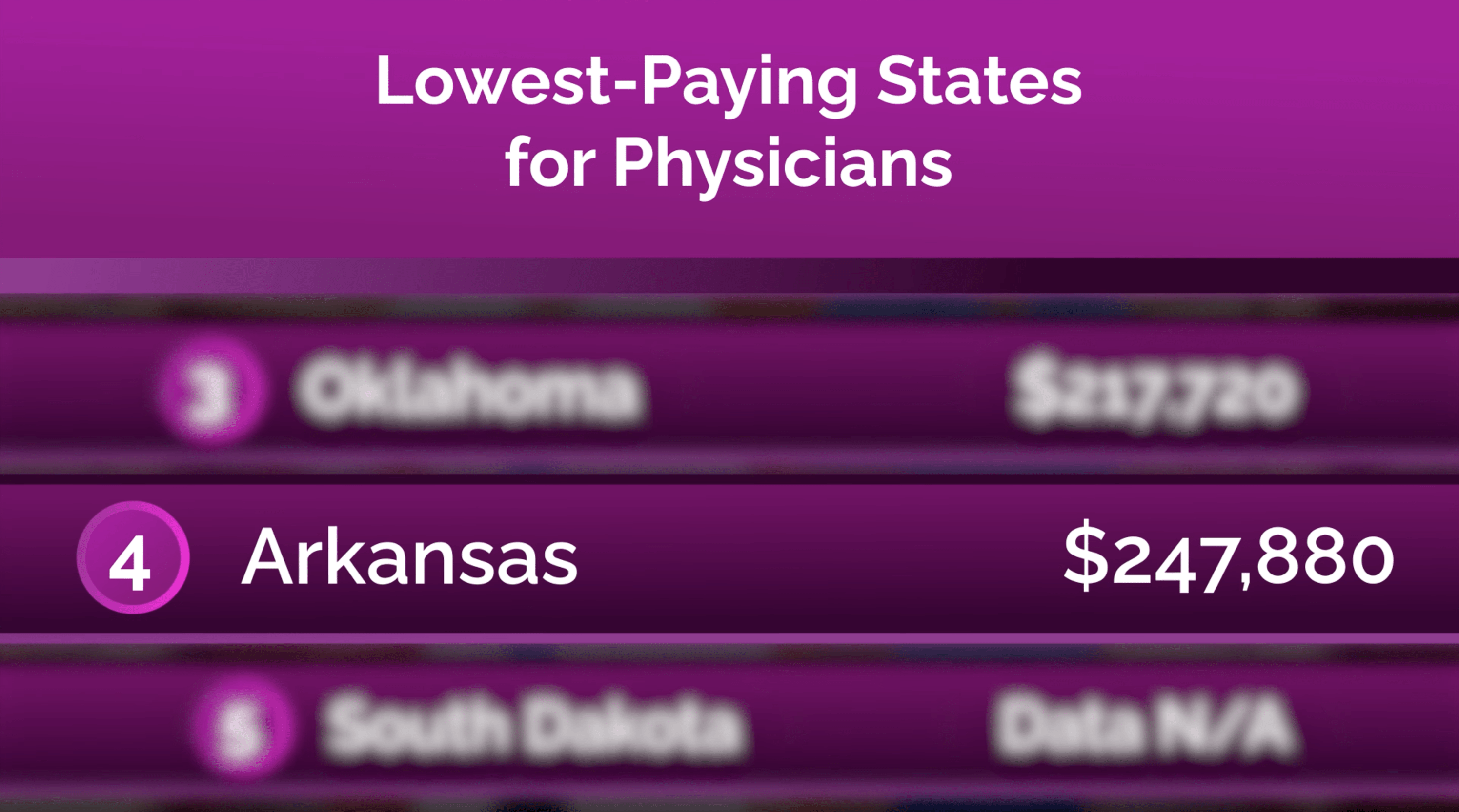
Nearly half of doctors experience burnout while ranking fourth-lowest nationally for compensation, which is a dangerous combination.
Residents face high mortality and rank third-worst for health disease risk factors, including diabetes, heart disease, and respiratory conditions.
While malpractice premiums stay low, the combination of low salaries and low physician density creates systemic delivery problems.
Next is the West Region, which encompasses Montana, Wyoming, Idaho, Utah, Colorado, Nevada, New Mexico, and Arizona.
The best state for doctors in the West Region is Utah.
Utah’s population maintains excellent health with low smoking, substance abuse, and cancer rates, making for rewarding patient care.
Doctors benefit from high compensation, minimal malpractice actions, and remarkably low burnout rates. The state also has multiple Level 1 trauma centers and top-tier medical facilities.
While malpractice premiums run higher, Utah maintains average lawsuit rates and enforces a $450,000 cap on noneconomic damages.
But the worst state for doctors is Nevada.
Nevada shows how good compensation can’t overcome systemic problems. Despite above-average physician pay, malpractice premiums and adverse actions are rising.
The patient population faces significant health challenges, with high obesity, heart disease, and behavioral health issues, which are complicated by behavioral health provider shortages.
Nevada’s 19th-highest death rate nationally and 41st-ranked healthcare system indicate broader problems, and physician burnout affects 38% of doctors.
And finally, we have the Pacific Region, which is home to Washington State, Oregon, California, Alaska, and Hawaii.
The best state for doctors to practice in is Oregon.
Physicians in Oregon enjoy high compensation with average malpractice premiums and low legal actions, and the state has multiple top-ranked health systems and Level 1 trauma centers.
Oregonians have access to comprehensive community programs covering medical, dental, and behavioral health. Plus, Oregon offers stunning natural surroundings, outdoor recreation, low physician burnout, and high retention of medical trainees.
But the worst state for doctors? You may be surprised to find out it’s actually California.
California epitomizes the “golden handcuffs” dilemma. Despite medical prestige and surprisingly low malpractice premiums, the practice reality is a challenging one.
High tax burdens and ultra-high living costs squeeze finances, and doctor shortages are worsening—the Central Coast meets only 49% of primary care needs.
Most telling is the fact that 42% of physicians report burnout despite the mild climate, national parks, and beaches. While world-class medical facilities exist, health outcomes vary significantly across the state’s counties.
Find everything you need to know about living in these states and how to get into the medical schools they’re home to in our State Guide series. Visit MedSchoolInsiders.com/states to access these free resources.

Did anything surprise you about these rankings? Drop a comment to let us know where you hope to practice.

Much of the advice premeds hear feels reassuring but quietly increases risk. Learn which common tips keep applicants stuck and what to do instead.

We break down the lowest-paid medical specialties in 2026, including average salaries, training length, lifestyle tradeoffs, and why compensation varies across fields.