In 2026, How Many Publications for Residency? (By Specialty)
How many publications do you need for residency? See 2026 research item averages by specialty and how they’ve changed since 2020.


By the time you reach USMLE Step 3, you are no longer a medical student fighting for residency interviews. You’re a resident physician actively practicing medicine. Naturally, the anxiety shifts. Instead of wondering how a score will affect your application, you’re likely asking a simpler question: What happens if I fail?
The reassuring news is that Step 3 has one of the highest pass rates of any USMLE exam. Historically, first-attempt pass rates for U.S. MD and DO graduates hover around 96–97%, according to official USMLE performance data.
In other words, the overwhelming majority of residents pass on their first try.
While it is still a scored exam, the emphasis is on meeting the passing standard rather than achieving a standout three-digit score. For most physicians, Step 3 is about checking a licensure requirement, not competing for rankings.
Compared to Step 1 and Step 2 CK, Step 3 is generally considered more manageable. Step 1, now pass/fail, historically had lower pass rates and was heavily weighted in residency applications. Step 2 CK has now taken up that mantle.
Step 3, however, is taken during residency and is not used in residency applications. By this stage, you are already practicing clinical medicine daily, and the exam reflects that reality.
To pass Step 3, you must meet the minimum passing score set by the USMLE, which is published annually on their official website. The scoring scale remains three-digit, but for most residents, the exact number is far less important than simply passing. Unlike earlier exams, there is little advantage to scoring exceptionally high unless you are in a particularly competitive academic trajectory.
One of the defining features of Step 3 is the Computer-Based Case Simulations (CCS). These interactive cases require you to order labs, initiate treatments, make disposition decisions, and manage evolving clinical scenarios in simulated real time.
This format distinguishes Step 3 from the primarily multiple-choice structure of Steps 1 and 2. Many residents find that mastering the CCS format is the most important part of preparation.
Failing Step 3 can feel discouraging, but the consequences are usually limited, especially compared to earlier licensing exams.
If you fail, you simply reapply and retake the exam in accordance with USMLE retake policies. Most residents who fail on the first attempt pass on the second. There is no permanent career-ending implication. Your transcript will reflect both attempts, but a subsequent pass resolves the licensing requirement.
Because Step 3 is taken during residency, it is not used for residency selection. Most programs require you to pass before graduation, and some may require a passing score to advance to the next year of training.
However, a single failed attempt rarely jeopardizes your residency position. Programs often provide support, and some may even allow dedicated study time for a retake.
Where Step 3 failure may carry more weight is in competitive fellowship applications. In highly selective subspecialties, such as cardiology, gastroenterology, or certain surgical disciplines, any exam failure can raise questions.
That said, fellowship programs typically do not give the actual Step 3 score much weight. A passing result is what matters. Strong clinical performance, research productivity, leadership, and letters of recommendation generally carry far greater influence.
A single failure, particularly if followed by a solid pass, is rarely disqualifying on its own.
Most preliminary residents take Step 3 before the end of their intern year. For categorical residents, timing is program dependent, but it is typically completed within the first one to two years of residency.
Some residents prefer to take it early to remove it as a stressor and potentially strengthen fellowship applications. Others wait until they feel more clinically confident. There is flexibility, but it is wise not to delay excessively.
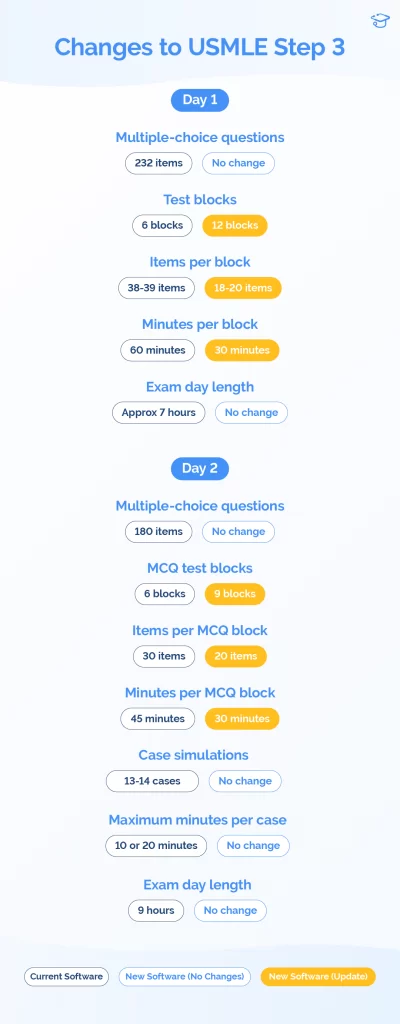
Step 3 is a two-day examination. The first day focuses on Foundations of Independent Practice and consists primarily of multiple-choice questions. The second day includes Advanced Clinical Medicine questions and the CCS cases.
The first day of testing includes 232 multiple-choice items across approximately 7 hours, including 45 minutes of break time and a 5-minute optional tutorial. The second day test session is approximately 9 hours. It begins with a 5-minute optional tutorial, followed by 180 multiple-choice items.
Note that minor changes were made to Step 3 starting in 2026.
Most residents prepare for two to four weeks. Preparation typically involves completing UWorld’s Step 3 QBank and practicing CCS cases through platforms such as CCSCases.com. Because residents are actively seeing patients, much of the material overlaps with daily clinical work. Extensive multi-resource study plans are usually unnecessary.
For most test-takers, Step 3 is not harder than Step 1 or Step 2 CK. It emphasizes management decisions and practical reasoning rather than memorization of detailed pathophysiology. Many residents find it more aligned with real-world clinical thinking.
In most cases, no. The score itself is rarely used for hiring or fellowship decisions. Passing is the primary objective. Exceptions may exist in highly competitive subspecialties or in applicants with multiple prior exam failures, but even then, a passing score is typically sufficient.
If you are concerned about passing, take a self-assessment exam, complete most of the UWorld questions, and ensure you are comfortable with the CCS format. Schedule the exam during a lighter rotation if possible.
The statistics are strongly in your favor, and with focused preparation, most residents succeed on the first attempt.
For most residents, preparation is straightforward. UWorld Step 3 and CCSCases.com are the core resources. Additional textbooks, video courses, or multiple question banks are typically unnecessary.
The goal is not to relearn medical school from scratch but to demonstrate safe, competent clinical decision-making at the level of an independently practicing physician.
Step 3 often feels intimidating simply because it is the final hurdle. In reality, it is designed to confirm readiness for unsupervised practice, not to create unnecessary barriers.
With a high first-attempt pass rate, limited long-term consequences for a single failure, and well-established preparation strategies, Step 3 is less about outperforming peers and more about completing the final step toward full medical licensure.
To secure yourself a pass, Med School Insiders offers dedicated Step 3 tutoring with tutors who aced every USMLE Step exam themselves.

How many publications do you need for residency? See 2026 research item averages by specialty and how they’ve changed since 2020.

Dermatologist vs Plastic Surgeon: Which is the best career path for you? We break down compensation, lifestyle, training, and the pros and cons of each career.