
In 2026, How Many Publications for Residency? (By Specialty)
How many publications do you need for residency? See 2026 research item averages by specialty and how they’ve changed since 2020.

Although the MCAT is 7.5 hours long, that doesn’t mean you have extra time to read every passage and answer every question at your own pace.
There are four sections. Each section is 90-95 minutes. Each asks 53-59 questions, which gives you about a minute and a half to correctly respond to each. To reach your dream MCAT score, your MCAT time management needs to be on point.
While daunting, it’s more than achievable with the right study and test-taking strategies.
In this post, we’ll break down MCAT timing, including the length of each section, what each section precisely assesses, study strategies to enhance your time management, and how to execute on the big day.
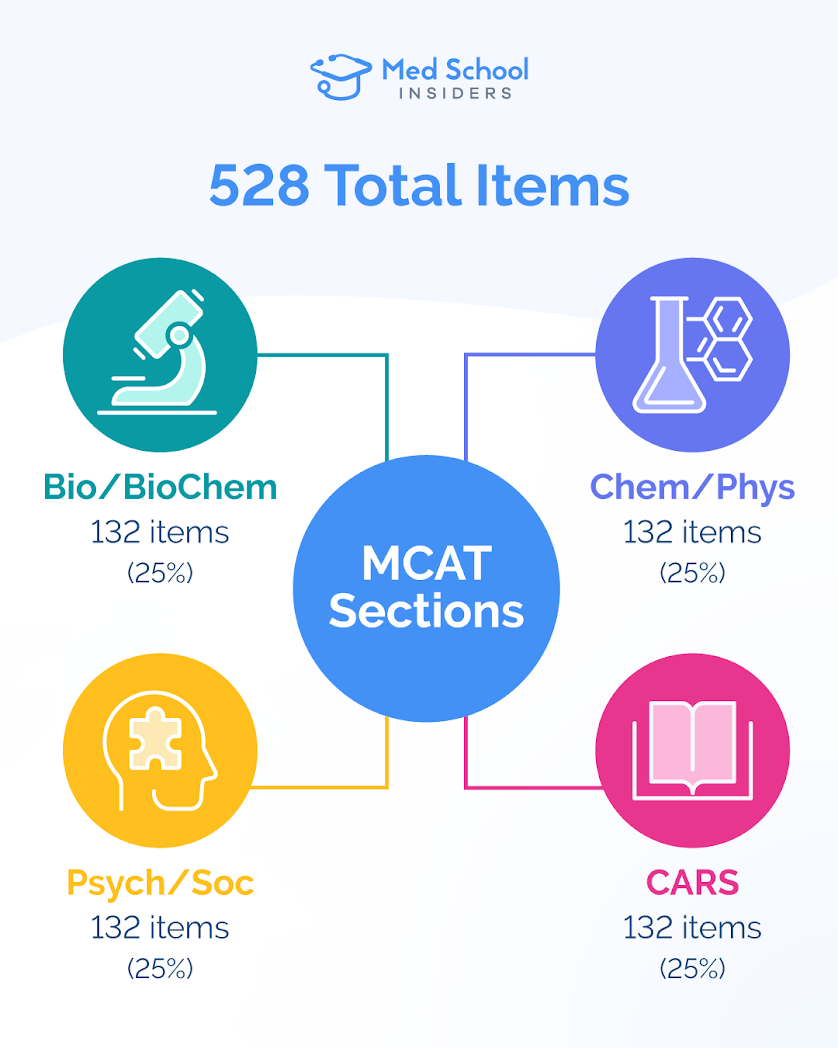
The MCAT is divided into four distinct sections:
Each section is worth 132 points, translating to a perfect MCAT score of 528. Sections 1, 3, and 4 require exceptional knowledge of scientific facts and concepts, scientific reasoning and problem solving, reasoning about the design and execution of research, and data-based and statistical reasoning.
Section 2, Critical Analysis and Reasoning Skills (CARS), is different from the other sections. True to its name, CARS assesses your critical analysis and reasoning skills. It doesn’t require any previous memorization. In this section, you’ll read passages and then answer questions about those passages.
Success on the CARS section relies heavily on your ability to quickly comprehend, analyze, and evaluate what you read.
Sections 1, 3, and 4 are each 95 minutes, and you have 90 minutes to complete the CARS section.
There are also three optional breaks: a 10-minute break after Chem/Phys, a 30-minute lunch break after CARS, and another 10-minute break after Bio/BioChem.
| MCAT Section | Time to Complete | Questions | Time Per Passage Question |
|---|---|---|---|
| Chem/Phys | 95 min | 59 questions | Approx 1.36 minutes |
| CARS | 90 min | 53 questions | Approx 1.42 minutes |
| Bio/BioChem | 95 min | 59 questions | Approx 1.36 minutes |
| Psych/Soc | 95 min | 59 questions | Approx 1.36 minutes |
| Total | 375 min (plus breaks) | 230 questions |
Note that the discrete questions littered throughout the science sections will likely take you less time, as you should not need to return to the corresponding passage in order to answer them.

Chem/Phys is the first section you’ll face on test day and accounts for 25% of your total score. There are 44 passage‐based questions and 15 discrete (non-passage-related) questions. Possible scores on Chem/Phys range from 118 to 132. You have 95 minutes to complete the 59 questions in this section, which gives you about a minute and a half to respond to each question.
This section tests introductory-level biology (5%), organic chemistry (15%), general chemistry (30%), introductory physics concepts (25%), first-semester biochemistry (25%), molecular biology, research methods, and statistics concepts. It also requires you to show scientific inquiry and reasoning, interpret research, and apply statistical skills as they relate to the natural sciences.
CARS is the second section and accounts for 25% of your total score. There are 9 passages, each between 500 and 600 words. For each passage, you will need to answer 5-7 questions for a total of 53 questions. Possible scores on CARS range from 118 to 132. You have 90 minutes to respond to the 53 questions in this section. Regarding MCAT CARS timing, you have about a minute and forty seconds to respond to each question.
That said, when budgeting your time, you’re better off looking at each passage. There are 9 passages, so you have a maximum of 10 minutes to read each passage and answer the corresponding 5-7 questions.
CARS is quite different from the other sections in that it does not require memorizing scientific facts; it requires dedicated skill-building in the months leading up to test day. CARS evaluates your reading comprehension and analytical reasoning. CARS is divided into three categories of critical analysis and reasoning skills covering a wide range of topics in the Humanities and Social Sciences.
The three categories are:
All of the information you need to answer the questions can be found in the text of the passage, which will be purposely complicated and dense.
The majority of premeds find the CARS section the most difficult MCAT section. However, there are plenty of things you can do to hone your critical analysis and reasoning skills before the big day.
Bio/BioChem is the third section of the MCAT and is worth 25% of your total score. It has 59 questions: 44 are passage-related, and 15 are discrete. Possible scores on Bio/BioChem range from 118-132. You have 95 minutes to complete the 59 questions in this section, which gives you about a minute and a half to respond to each question.
This portion of the test combines your knowledge of biological and biochemical concepts, such as your understanding of cells and organs, as well as how these systems work together, along with your scientific inquiry and reasoning skills. Specifically, this section tests first-semester biochemistry (23%), introductory biology (65%), general chemistry (5%), and organic chemistry (5%).
Psych/Soc is the last section of the MCAT and accounts for 25% of your total score. It has 59 questions: 44 are passage-related, and 15 are discrete. Possible scores on the Psych/Soc range from 118 to 132. You have 95 minutes to complete the 59 questions in this section, which gives you about a minute and a half to respond to each question.
Psych/Soc assesses your understanding of psychological, social, and biological factors that shape health. It requires knowledge of behavior and behavior change, perceptions of self and others, cultural and social differences, and the influence of other social relationships. Specifically, this section tests introductory psychology (65%), introductory sociology (30%), and introductory biology (5%).
MCAT practice questions and tests are invaluable to your MCAT studying, as there is no better way to get familiar with the test than simulating it. Start taking them almost as soon as you begin your studying, about two weeks after you start content review. This will help you understand what MCAT questions are actually like, enabling you to study much more effectively.
Taking MCAT practice tests early will not only allow you to determine where you’re starting from knowledge-wise, but also help you figure out your own MCAT pacing strategy. Where is your baseline? How much MCAT time per question do you need?
Knowing your own strengths and weaknesses can help you focus more effort on the areas that need improvement. For example, you may determine that Psych/Soc and Bio/BioChem are strong areas for you, which means you need to put more focus on preparing for CARS and Chem/Phys.
Practice questions and tests are also effective forms of active learning.
When choosing which MCAT practice tests to use, keep in mind that AAMC practice tests are most similar to the real thing, as they are designed by the official test makers. Therefore, your experience with AAMC tests, as well as your predicted scores, will be highly representative of how you will actually perform on test day.
During your study period, take a practice test under timed conditions at least once every one to two weeks. This way, you can identify weak points, tangibly understand how much time you have to complete each question, learn how different concepts will be tested, and track your progress. Plus, you’ll also learn quite a bit of high-yield content in the process.
Once you begin to feel more comfortable with the content, start treating your practice tests like the real deal. The MCAT starts at 8 am, and you need to arrive 45 minutes early.
Get up early. Wear the same clothes. Eat the same breakfast. Drive somewhere other than your home to take the test, like a library. Time yourself and practice under the actual time constraints of the day to figure out how to pace yourself on the MCAT. Only take a break after you complete each section.
Simulate the day’s events as best you can to get a sense early on of whether you naturally manage your MCAT timing well and of your overall strengths and weaknesses.
This is the best time to experiment with what works best for you. For most students, taking multiple short breaks at the start of the day is best. Longer breaks are best utilized around lunchtime and the second half of the day.
Casually working through MCAT practice tests and taking multiple breaks throughout each section could cause you to view the MCAT as less important and stressful than it actually is. Even if it’s not a full-blown practice test, give practice questions your complete focus.
Much of the utility of practice questions is lost if you’re doing them randomly or without a plan. Approach the questions with the same intense focus you’ll bring on test day, and practice in a timed environment early.
The MCAT is a colossal undertaking with major ramifications for your entire medical education and future career. We don’t say this to scare you. We say it so that you’ll understand the serious stakes of this test. You won’t get extra time. Medical schools will see your score. While you can technically take the MCAT more than once and even void your MCAT, keep this safety net out of your mind. You’re playing for keeps.
There’s nothing casual or laid back about the MCAT, so there’s no reason your approach to practice tests should be either.
Put your game face on, and treat each MCAT practice test like the real deal.
By far, one of the most essential parts of practice tests and questions is reviewing your incorrect answers as well as your correct answers, as you may get a question correct for the wrong reasons.
If this happens on test day, it can translate to substantial point differences. You can also get a question wrong despite having a good understanding of the underlying concepts. Did you confuse similar concepts? Did you simply misread the question?
Do not neglect the vital opportunity to understand precisely where an error occurred. Not only do you need to know why an answer is correct, but you must also know why the other answers are incorrect.
You are far more likely to repeat the same mistakes on test day if you don’t learn from them by reviewing your answers. Thoroughly review each question so that you understand each underlying concept, and make flashcards for anything you consistently get wrong.
You want to find a study and test-taking rhythm as soon as possible so that you can build a test-taking strategy toward the beginning of your studying. To accomplish this, it’s important to experiment with different strategies to determine what works best for you.
Some people are excellent at navigating multiple-choice questions. Some people are naturally gifted at keeping pace while testing. You won’t know what will work for you until you test yourself.
Take time to test out various strategies early on in your studying so that you can continue to hone your experience with them. Start by employing the strategies that make the most sense to you and see how you perform. You don’t want to try something new at the last minute, and you also don’t want to use every strategy under the sun.
As you experiment with different strategies, narrow them down. Employing too many will actually impede your focus and undermine your sense of direction.
There are so, so many strategies out there, and a lot of them are overkill. They are only useful if you need to target a specific weak area of your test-taking.
Simple is better. Each strategy could potentially work for you, but it’s best not to use all of them. Try out an MCAT practice test without employing any of the strategies first, then read up on them afterward and see what you lean towards. Whether you naturally gravitate to highlighting the passages over summarizing them or lean towards reading the questions first vs. previewing all the passages and selecting the ones you do first, go with your gut.
Our competitors may tell you that you need a combined x + y + z + a + b strategy, but we disagree. Stick to your top one, two, or three strategies based on what works for you, and don’t worry about the other ones.
By far, the most important strategy you can employ to enhance your MCAT timing is to practice in a timed environment as early as possible. Experiment to see what works with you, but keep this top of mind.
CARS isn’t something you can study for; instead, it’s something you prepare for. CARS evaluates your reading comprehension and analytical reasoning.
Reading comprehension refers to our ability to understand and interpret what we read. This skill is essential to your success on the MCAT.
Unlike the other three sections of the MCAT, success does not depend on your ability to memorize scientific facts. This means CARS demands a whole new approach to studying. CARS requires dedicated skill-building in the months leading up to test day, as reading comprehension and critical analysis are not skills you can learn overnight or in a few short weeks.
Begin using practice problems early to gauge how much preparation you need. Reading comprehension and critical thinking are skills that will help you in all aspects of your life, so if you know you hope to go to medical school, you can begin honing these skills as early as high school. This involves making reading a daily habit and building your active reading skills to ensure you fully grasp what you’re reading.
Begin answering CARS practice questions before your dedicated MCAT study time for the other three sections, as honing your CARS skills will take longer.
As we covered above, when it comes to MCAT minutes per question, you only have about a minute to a minute and a half to answer each question, depending on whether the question is discrete or passage-based.
If you get hung up on one question, it can derail your time. Take time to consider the question, but don’t focus on any one question for too long. This is a key way to manage your timing.
An incorrect answer won’t derail your MCAT score, but if you spend too much time on one question or on one passage, it will take away from the time you can spend on the remaining questions and passages.
Flag any questions you struggle with and circle back to them at the end. If you don’t know the answer, guess. You have a 1-in-4 chance of getting it right. Do not leave any question blank. This cannot be emphasized enough.
However, this advice doesn’t necessarily apply to the CARS section. We don’t recommend automatically flagging and then circling back to confusing questions in the CARS section, as the passage is freshest in your mind after you’ve just read it. If you circle back to these questions at the end, you’ll need to reread the passage, which will take away from your precious MCAT time per passage.
If you’re completely baffled and don’t know the answer, it’s best to guess after you’ve just read the passage as opposed to waiting until the end of the test.
Plus, it’s important to note that CARS questions typically follow the sequence of the passage. Question #1 will likely be about a concept located in the first few paragraphs, and the final question will likely be about a concept toward the end of the passage.
It is vital to get in the zone when taking the MCAT. You don’t want your focus disrupted, which is why MCAT testing centers hand out noise-canceling headphones to test takers and install dividers between each testing station. Distractions are a major problem.
You don’t have the time to become distracted, which is exactly what’s going to happen if you keep your focus on the clock instead of the test.
Checking the time after you complete each question will disturb your flow state. You’re inviting anxiety to pollute your concentration. It’s already hard enough to get in the flow on testing day, especially if you haven’t practiced. Don’t make it more difficult.
If you’ve consistently taken practice tests under the realistic time constraints once every one to two weeks for the previous couple of months, the pacing of the MCAT will be quite familiar to you.
Focus on getting into the zone when you take the MCAT. Check the clock at regular intervals, but ensure the intervals are spaced far enough apart for you to reach your flow state.
As much as it is important to manage your time, it’s more important to stay focused and attention-driven. Time management does not support active learning.
As we touched on in the previous point, checking the clock after every question disrupts your flow state. It’s best to check the clock every 15 or 30 minutes or after each passage. An important milestone to take note of is when you reach question 30 in each science section, as this is about the halfway point. If you’re on track, you should have roughly 45-48 minutes left on the clock.
In the CARS section, a key milestone to take note of is when you reach question 26, as this is approximately the halfway point. You’ll know you’re on track if you still have 45 minutes or so left on the clock.
You could also consider breaking the test up into thirds. With this method, it’s ideal to be on question 20 at the 30-minute mark, question 40 at the 60-minute mark, and question 59 at the 90-minute mark. This way, you still have about five minutes to look over any questions you initially skipped.
Experiment with implementing milestones early on in your MCAT practice test sessions to see what works for you. After a few tests, do you find you take too long on each passage and/or question, or are you able to move through the test efficiently? Every test taker is different.
If you find that looking at the clock every few minutes keeps you motivated, do that. However, keeping one eye on the clock can be very distracting, so test out the milestone strategy early on.
If you’re serious about your MCAT score, and you should be, the Med School Insiders MCAT Course gives you gold standard content, five practice tests, and guidance from 100th percentile scorers, backed by the industry’s first-ever honest 510 score guarantee. There’s also a 10-day, 100% money-back guarantee, so you can try it out at zero risk.

How many publications do you need for residency? See 2026 research item averages by specialty and how they’ve changed since 2020.

Dermatologist vs Plastic Surgeon: Which is the best career path for you? We break down compensation, lifestyle, training, and the pros and cons of each career.