
Indiana Medical Schools—2026-2027 Guide to Acceptance
Everything you need to know about going to medical school in Indiana—how to apply, tips for acceptance, and how to decide if Indiana is right for you.


Are you considering applying to medical school in Indiana? The Hoosier State is renowned for the Indy 500, a massive sports culture, numerous festivals, and Midwestern charm. Unfortunately, it’s also known for its significant healthcare disparities and high obesity rates.
But what’s it like to attend medical school in Indiana, and how do you get accepted?
In this post, we’ll break down everything you need to know about going to medical school in Indiana, including where the medical schools are located, what it’s like to live in Indiana, how to apply, and tips for gaining acceptance to medical schools in Indiana.
Are you applying to other states? Utilize our State Guide series for an in-depth look at the application process in various states across the country.
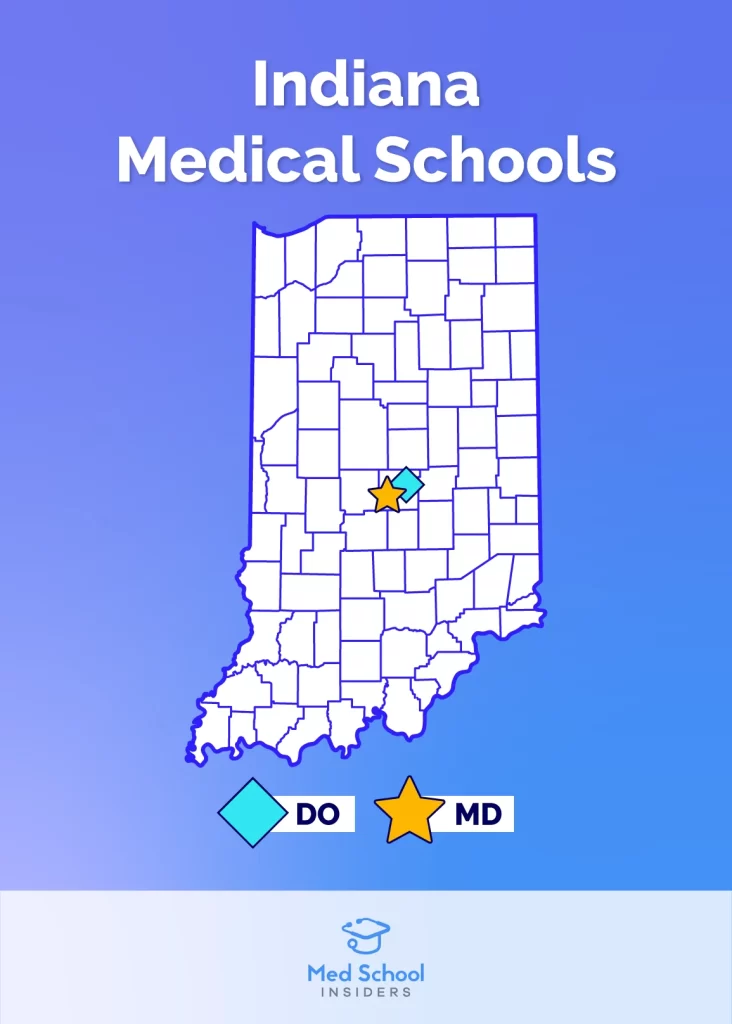
There are two medical schools in Indiana. One is allopathic (MD), and the other two are osteopathic (DO).
Allopathic Medical Schools in Indiana (MD)
The Indiana University School of Medicine was founded in 1903 and holds a distinctive place in American medical education: it’s the largest medical school in the United States.
Comprised of five basic science departments and 20 clinical departments, the IU School of Medicine operates across nine campuses throughout Indiana, offering an exceptionally broad training experience that sets it apart from traditional single-campus medical schools.
The Indiana University School of Medicine’s mission statement is:
“It is the mission of Indiana University School of Medicine to advance health in the state of Indiana and beyond by promoting innovation and excellence in education, research and patient care.”
What makes the IU School of Medicine truly unique is its statewide model. With campuses in Bloomington, Evansville, Fort Wayne, Indianapolis, Muncie, Northwest-Gary, South Bend, Terre Haute, and West Lafayette, the school offers students opportunities to train in diverse clinical environments, ranging from major tertiary care centers to community hospitals, ambulatory care settings, and physician offices across the state.
This geographic diversity means students gain exposure to varied patient populations and healthcare delivery models that reflect the real-world complexity of American medicine.
Starting with the Class of 2020, the school introduced a modernized curriculum that reflects contemporary healthcare delivery and prepares students to practice in team-based, interdisciplinary settings. The MD curriculum is organized into three distinct phases spanning four years.
Phase One spans the first two years and focuses on building foundational scientific knowledge while integrating clinical skills from the outset. Students progress through a carefully sequenced series of courses: Human Structure, Molecules to Cells and Tissues, Fundamentals of Health and Disease, Host Defense, and Neuroscience and Behavior. Running throughout the entire first year are Foundations of Clinical Practice 1 and Health Systems Science 1, ensuring that basic science learning is continually connected to clinical application.
Phase Two constitutes the third year and centers on required clinical clerkships in core disciplines. Students rotate through outpatient, inpatient, triage, and interventional settings. Throughout the clerkship year, students participate in Health Systems Science 3: Sessions to Enhance Physician Success (HSS3-STEPS), an innovative program centered on the quadruple aim in healthcare: improving provider wellbeing, enhancing quality of care and patient experience, strengthening population health, and lowering costs.
Phase Three, the fourth year, emphasizes professional development, individualized career exploration, and advanced clinical learning to prepare for residency. Students take on progressively greater responsibilities in patient care and develop self-directed, lifelong learning skills.
One notable feature is the optional Scholarly Concentrations program, which allows students to delve deeply into specialized topics such as Business of Medicine, Human Sexuality and Health, or Urban Medicine and Health Care Disparities. Students benefit from the school’s statewide network of experts and complete scholarly projects that strengthen residency applications.
The curriculum emphasizes collaboration within learning communities and interprofessional work. Students receive robust academic advising and career counseling throughout their training.
Median Academic Scores of Matriculants:
The Indiana University School of Medicine Secondary Questions.
In-State vs. Out-of-State Preference:
| In-State | Out-of-State | |
|---|---|---|
| Applicants | 641 | 5696 |
| Matriculants | 307 | 58 |
The Tom and Julie Wood College of Osteopathic Medicine at Marian University (MU-WCOM) was founded in 2010. Located in Indianapolis, the institution is grounded in Franciscan values that emphasize the health of mind, body, and spirit.
Marian University College of Osteopathic Medicine’s mission statement is:
“To be a Catholic university dedicated to excellent teaching and learning in the Franciscan and liberal arts traditions. We welcome students of all faiths who seek an educational experience framed within the context of our Franciscan sponsorship values of dignity of the individual, peace and justice, reconciliation, and responsible stewardship. Our understanding of these values is informed by reflection on the life of Jesus Christ and prayer.”
MU-WCOM features state-of-the-art classrooms, laboratories, study areas, and a cutting-edge simulation center. The curriculum is designed to progressively develop the seven core competencies outlined by the National Board of Osteopathic Medical Examiners (NBOME) through an integrated, patient-centered approach that prepares students for careers across all areas of medicine.
The learning environment at MU-WCOM is built on the four Franciscan Values:
Students are referred to as Osteopathic Medical Students (OMS) and progress through four years designated as OMS-1 through OMS-4. The program employs innovative teaching methods, including lectures, laboratories, case-based seminars, podcasts, team-based learning, and early clinical exposure.
A distinctive feature of MU-WCOM is the Professional Identity Formation (PIF) series, a longitudinal curriculum delivered across all four years. This program supports personal and professional growth through five major areas: wellness, lifelong learning, purposeful career development, dignity, justice, unity, and leadership in osteopathic medicine. The goal is to develop transformational leaders in the field of osteopathic medicine.
The preclinical years (OMS-1 and OMS-2) offer an integrated and team-based approach. The curriculum integrates didactic and clinical competencies, includes interprofessional education with nursing students, incorporates clinical applications into biomedical science courses, and provides clinical experiences during the first two years of study.
Students work in state-of-the-art anatomy labs to explore human body systems and structures, refine hands-on treatment skills in the osteopathic manipulative medicine (OMM) lab, and practice examination techniques in advanced simulation and examination rooms.
The clinical years (OMS-3 and OMS-4) shift focus to direct patient care settings. The third year consists of ten months of clinical rotations, including two one-month rotations each in Family Medicine, Surgery, and Internal Medicine, as well as one month each in Psychiatry, Pediatrics, and Obstetrics/Gynecology, followed by one elective month.
Students work closely with physicians and preceptors, applying their knowledge in real-world healthcare settings. They also study for end-of-rotation Comprehensive Osteopathic Medical Achievement Tests (COMATs) and prepare for COMLEX Level 2-CE.
During the third year, students begin exploring their desired medical specialties, working with faculty to obtain letters of recommendation and preparing residency applications. Fourth year includes ten months of clinical rotations with sub-internships, selectives, and electives that align with students’ career goals and specialty interests.
Average Academic Scores of Matriculants:
Marian University College of Osteopathic Medicine Secondary Questions.
Indiana, also known as the Hoosier State, is situated in the Midwest region of the United States. It shares borders with five different states and a Great Lake. Michigan borders it to the north and northeast, and Lake Michigan touches its northwest corner. Ohio lies to the east, while the Ohio River and Kentucky define the state’s southern and southeastern boundary. The Wabash River and Illinois border Indiana to the west.
The IU School of Medicine is unique in that it has nine campuses throughout the state of Indiana, from highly urban (Northwest-Gary) to highly rural (Terre Haute).
Indianapolis, home to both the IU School of Medicine’s main campus and Marian University, is a thriving metropolitan area with a population of approximately 880,000 within the city and nearly 2.1 million in the metro area. It’s the 15th largest city in the United States and offers an appealing blend of urban amenities and Midwestern affordability.
Indiana is not a particularly large state, so the campuses are relatively close together. It takes approximately 1.5 hours to drive east to west, and 3.5 to 4 hours north to south.
Most residents, including medical students, have cars. Indianapolis is very car-friendly with ample parking and relatively light traffic. The city has public transportation, known as IndyGo, which includes the Red Line rapid transit; however, it’s not as extensive as those of larger metro systems, and is considered by Hoosiers to be unreliable.

So, how much does medical school cost in Indiana?
| Indiana Medical School | Yearly Tuition In-State | Yearly Tuition Out-of-State |
|---|---|---|
| Indiana University School of Medicine | $40,116 | $66,855 |
| Marian University College of Osteopathic Medicine | $59,850 | $59,850 |
View the most recent AAMC tuition data.
Applying to medical school is a major financial undertaking that costs far more than just the initial application fees. Prospective students must account for primary application costs, individual secondary application fees for each school, expenses for required tests like the MCAT, and all related study materials. Once interviews begin, travel costs can quickly escalate, especially when visiting various programs nationwide.
Financial planning extends well past the initial admissions cycle. During medical school, you’ll need to budget for daily expenses, including housing, transportation, and groceries. It’s also crucial to factor in costs for maintaining your wellbeing, including support for your physical and mental health, as well as participation in social activities essential for connecting with classmates.
The good news is that Indiana’s comparatively affordable cost of living helps offset many of these expenses compared to attending medical school in larger metropolitan hubs, making it easier to manage your budget over the four or more years of training.
| Acceptance Rate | Overall | In-State | Out-of-State |
|---|---|---|---|
| Indiana University School of Medicine | 5.7% | 47.9% | 1.0% |
Indiana is known as the “Crossroads of America” due to its central location and extensive network of interstate highways. The state features diverse geography, including rolling hills, farmland, forests, and sand dunes along Lake Michigan.
The Hoosier State has four distinct seasons. Summers are warm and humid with temperatures ranging from the mid-70s to mid-80s, while winters are cold with temperatures in the 20s and 30s and regular snowfall, particularly in northern Indiana. Spring and fall are mild and pleasant with beautiful autumn foliage. But be prepared for unpredictable weather. Midwesterners joke that if you don’t like the weather, just wait a few hours.
Indianapolis, the state capital, is best known for the Indianapolis 500, the world’s largest single-day sporting event. Sports culture runs deep. Indianapolis is home to the NFL’s Colts and the NBA’s Pacers.
One of the biggest advantages of attending medical school in Indiana is affordability. The cost of living in Indianapolis is significantly below the national average, particularly for housing. This makes a real difference when managing student loan debt.
If you’re assigned to one of IU School of Medicine’s regional campuses, you’ll experience smaller college towns like Bloomington, West Lafayette, South Bend, or Muncie. These towns offer a more intimate, college-focused environment with lower costs of living and tight-knit communities.
For outdoor recreation, Indiana offers numerous state parks, including Turkey Run State Park, Indiana Dunes National Park along Lake Michigan, and Brown County State Park. The Monon Trail in Indianapolis is a 24-mile path perfect for running and cycling.
The Midwest is known for its friendly, down-to-earth culture, and Indiana exemplifies this. People are welcoming and community-oriented. The pace of life is slower than in major coastal cities. Indiana leans conservative outside of Indianapolis and college towns, and basketball is almost a religion here—high school basketball draws massive crowds.
Indiana’s central location makes travel convenient. Chicago is approximately three hours north, Cincinnati is two hours southeast, and Louisville is less than two hours south. Indianapolis International Airport offers direct flights to major US cities.
For medical students, Indiana offers a diverse range of clinical experiences, from urban healthcare in Indianapolis to rural healthcare in smaller towns and communities. The state faces health challenges, including high rates of obesity, diabetes, cardiovascular disease, and opioid addiction, providing significant exposure to pressing public health issues.
Indiana may not have the glamour of coastal states or dramatic mountain scenery, but it offers solid medical education, affordable living, friendly communities, and genuine Midwestern hospitality.
Navigating the application process for the only allopathic (MD) medical school in Indiana is streamlined through the American Medical College Application Service (AMCAS). This platform, managed by the AAMC, acts as a centralized processing service for nearly all US medical schools.
Instead of preparing separate application packages for each institution, you complete one comprehensive application via AMCAS, which is then distributed to your chosen schools.
Admissions committees employ a holistic review process, meaning your application must be strong across multiple essential elements. You’ll need competitive academic credentials (your GPA and MCAT score), a powerful personal statement that clearly communicates your narrative, persuasive letters of recommendation from faculty and mentors, and a thorough Work and Activities section highlighting your diverse experiences.
Currently, Indiana medical schools don’t mandate the Casper assessment or the AAMC PREview Professional Readiness Exam.
Following the submission of your primary AMCAS application, schools usually send secondary applications within two to four weeks. Unlike the centralized primary, you’ll complete and submit these secondaries directly to each institution.
Interview invitations can arrive anytime from late August through the following spring, depending on when schools review your completed application.
The AMCAS application typically launches in early May, with the submission window opening in late May or early June. For example, if you plan to matriculate in the fall of 2027, you’ll begin this process in the spring of 2026.
Understanding rolling admissions is crucial to your success. Medical schools do not wait for the final deadline; they evaluate applications immediately as they arrive. Submitting your application early ensures you receive secondary applications sooner, leading to earlier interview slots and ultimately, better odds of acceptance. Given the limited number of seats in each program, delaying your submission significantly reduces your competitive edge.
The key strategy is urgency. Submit your AMCAS application as soon as the system opens. This necessity for speed extends to completing secondary applications and scheduling interview appointments promptly. The primary interview season generally runs from September through the following March.
Here’s what you should be working on month-by-month: Medical School Application Timeline and Monthly Schedule. (Updated every application cycle.)
Applying to Indiana’s only osteopathic (DO) program follows a trajectory very similar to the MD admissions process. You’ll still need competitive transcripts, MCAT scores, a personal statement, letters of evaluation, and a detailed experiences section to submit a complete file.
The major distinction, however, is the application platform: you will use the American Association of Colleges of Osteopathic Medicine Application Service (AACOMAS) for centralized processing instead of AMCAS.
Crucially, DO programs require applicants to demonstrate a clear commitment to osteopathic medicine. Your personal statement must specifically address why you are choosing osteopathic training, and you must secure at least one letter of recommendation from a practicing Doctor of Osteopathic Medicine (DO).
If you’re a Hoosier, it’s a no-brainer to apply to the Indiana University School of Medicine, as the institution shows a massive preference for in-state applicants
Last year, 307 of 641 in-state applicants were accepted. That’s nearly half (48%). Even if you’re not sure you want to go to IU-SOM, Hoosiers have a one in two chance of acceptance, and a single acceptance is better than none.
The story is much bleaker for out-of-state applicants. Out of 5696 applicants, only 467 were invited to interview, and only 58 were accepted. That’s 1%. So if you’re not a Hoosier, know that earning acceptance to IU-SOM is an uphill battle.
Your application needs to tell a consistent story about who you are and what you want to do in medicine. This isn’t just about your personal statement—every piece of your application should reinforce the same central theme, from your experiences to your letters of recommendation to your interview responses.
Indiana faces significant healthcare challenges, including high rates of obesity, diabetes, cardiovascular disease, and opioid addiction. The state also has substantial rural and underserved populations, particularly outside of Indianapolis and college towns. Indiana medical schools are specifically looking for students who demonstrate a genuine commitment to addressing these issues and serving medically underserved communities.
Your application must show concrete evidence—not just stated intentions—of your dedication to serving the underserved. Admissions committees can spot inconsistencies immediately.
Suppose you claim to be passionate about serving rural communities, but your activities don’t demonstrate any volunteer work in underserved areas, community health involvement, or experience working with diverse populations. This disconnect in your application’s narrative will hurt your chances.
Your narrative should answer: Why do you want to study and practice in Indiana specifically? How have you already demonstrated your passion for addressing Indiana’s healthcare challenges, or the needs of underserved rural populations in general? What longitudinal experiences show that your commitment isn’t just theoretical?
These experiences may include sustained volunteer work at free clinics, community health programs, or projects involving rural or underserved populations, as well as meaningful involvement with organizations addressing substance use disorders or chronic disease management.
Given the IU School of Medicine’s statewide model with nine campuses, showing flexibility and enthusiasm for training in smaller cities like Muncie, Terre Haute, or South Bend, rather than just Indianapolis, can strengthen your application. Similarly, Marian’s emphasis on Franciscan values and serving vulnerable populations should be reflected in your experiences and goals.
The key is alignment backed by authentic proof. Indiana medical schools don’t need more physicians who will leave for coastal cities after training. They need doctors who genuinely understand and are committed to tackling the state’s unique healthcare challenges and serving communities throughout Indiana.
Learn How to Develop a Cohesive Narrative for Medical School Applications.
Yes, by and large, Indiana is a safe and affordable state for students to live in.
Yes, both Indiana medical schools favor in-state applicants. 48% of in-state applicants to the IU School of Medicine were accepted last year, and 57% of the student body at Marian University consists of in-state applicants.
There is one allopathic (MD) medical school, the Indiana University School of Medicine, and one osteopathic medical school (DO), the Marian University College of Osteopathic Medicine.
The tuition rates at both medical schools are largely consistent with those of schools nationwide; however, the cost of living is lower than the national average, which does make daily life more affordable.
Indiana’s medical schools are highly regarded for their robust research programs, commitment to primary care education, and dedication to addressing the state’s severe healthcare workforce shortages.
However, selecting a medical school involves more than just academics. When making your final decision, consider whether the campus culture and surrounding community are places where you will genuinely thrive during your four years of intensive training.
Indiana offers affordability, a passionate sports culture, and a healthy dose of Midwestern charm. However, the Hoosier State also suffers from significant healthcare disparities. But if you’re enthusiastic about serving the underserved, the Hoosier State could be the one for you.
Learn more: How to Decide Which Medical Schools to Apply to (12 Important Factors).
Whether you prefer the bustling cities of the Northeast to the calm landscapes of the Pacific Northwest, the goal remains the same: admissions committees are looking for resilient, well-rounded, and community-minded students ready to enrich their student body. Simply going through the motions won’t suffice.
The reality is, a genuinely competitive applicant is highly regionalized. Each area of the country presents its own distinct clinical environment, ranging from the intricacies of urban public health in New York to the specialized field of border health in the Southwest. Crucially, your student life outside of the hospital will also be profoundly different based on your choice.
To succeed, you need more than a standardized, one-size-fits-all application. You need a custom-fit strategy that speaks directly to the mission of your target schools and acknowledges the specific social and medical realities of their state.
The good news? Med School Insiders has already done the heavy lifting.
We’ve compiled comprehensive State Medical School Guides to give you the strategic edge you need to align your application perfectly with a school’s priorities and help you confidently choose a location where you’ll be happy for four years. These detailed guides break down everything: unique research opportunities, regional healthcare needs, and the unvarnished pros and cons of life outside the classroom.
Stop guessing and start applying smarter. Discover where your passion truly fits by exploring our most popular State Guides:
Don’t leave your medical school future up to chance. Contact us today to take advantage of our one-on-one strategic advising, application editing, and mock interviews. We’re here to help you transform your application from good to undeniable.

Everything you need to know about going to medical school in Indiana—how to apply, tips for acceptance, and how to decide if Indiana is right for you.

Much of the advice premeds hear feels reassuring but quietly increases risk. Learn which common tips keep applicants stuck and what to do instead.